Assistance dog team certification
Read on to learn how certification works, how it differs from alternative offers, and read our testimonials.
The certification process — step by step
During admission, we ask for basic information about you and your dog and some documentation.
Your information is treated confidentially and according to high data protection standards. We are supported in the implementation of our data protection processes by an independent data protection officer who advises us on data protection compliance.
Your final commitment and payment are required only if you are admitted to the assessment.
The next exam cycle starts in spring, 2026.
Secure your place on the waiting list and subsidized fees now, obligation-free.
Data protection laws require an external data protection agent for ALL organizations, large or small, that come into contact with your health data.
Unfortunately, traditional procedures are rarely in compliance.
You pass your theoretical knowledge exam beforehand to minimize the duration of your live exam.
A handbook, provided by the Assistance Dog Foundation free of charge, can help you prepare.
The exam is done remotely via video conferencing in multiple-choice format and lasts 30 minutes.
It uses a modern set of proctoring technologies to ensure integrity. We provide accessibility and technical support as needed.
Your exam follows a detailed protocol, aligned to global standards. This ensures we cover all relevant areas and your certificate is comparable.
In addition to the list of assistive tasks that your assistance dog masters, which you submitted during admission, you may also submit a list of locations you are familiar with. We like to incorporate these, where possible. Your route is mailed to you on the morning of your live exam.
You will also supply us with any special requirements and an emergency protocol.
How it works: the day of your exam
- You meet your video proctor at the agreed location.
- She activates a discreet multi-camera setup, incl. a small wearable camera for your viewpoint.
- You and your proctor are connected to the exam supervisor via encrypted livestream and audio.
- The remote supervisor guides the route and tasks, focused and undistracted.
- You and your dog complete your route with self-determination and minimal interruption.
- The proctor only monitors the technologies — you are not judged during the exam.
- All documentation is consent-based, with strictly controlled access and archiving policy.
- Your examiners assess you later — calmly, undistracted, and with monitored outcome quality.
What you can expect
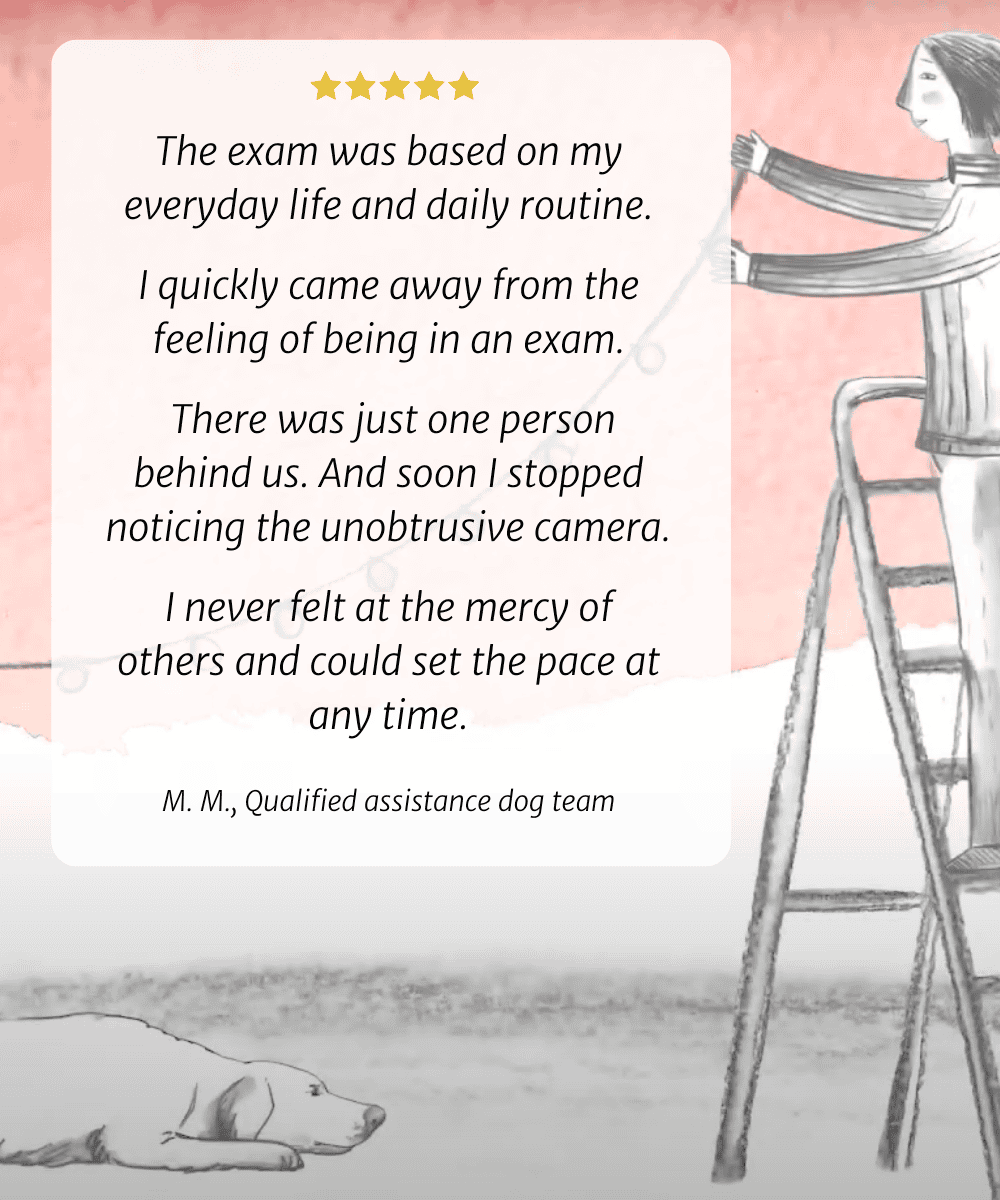
- Real-life scenarios on your daily routes, in places you typically visit, where possible.
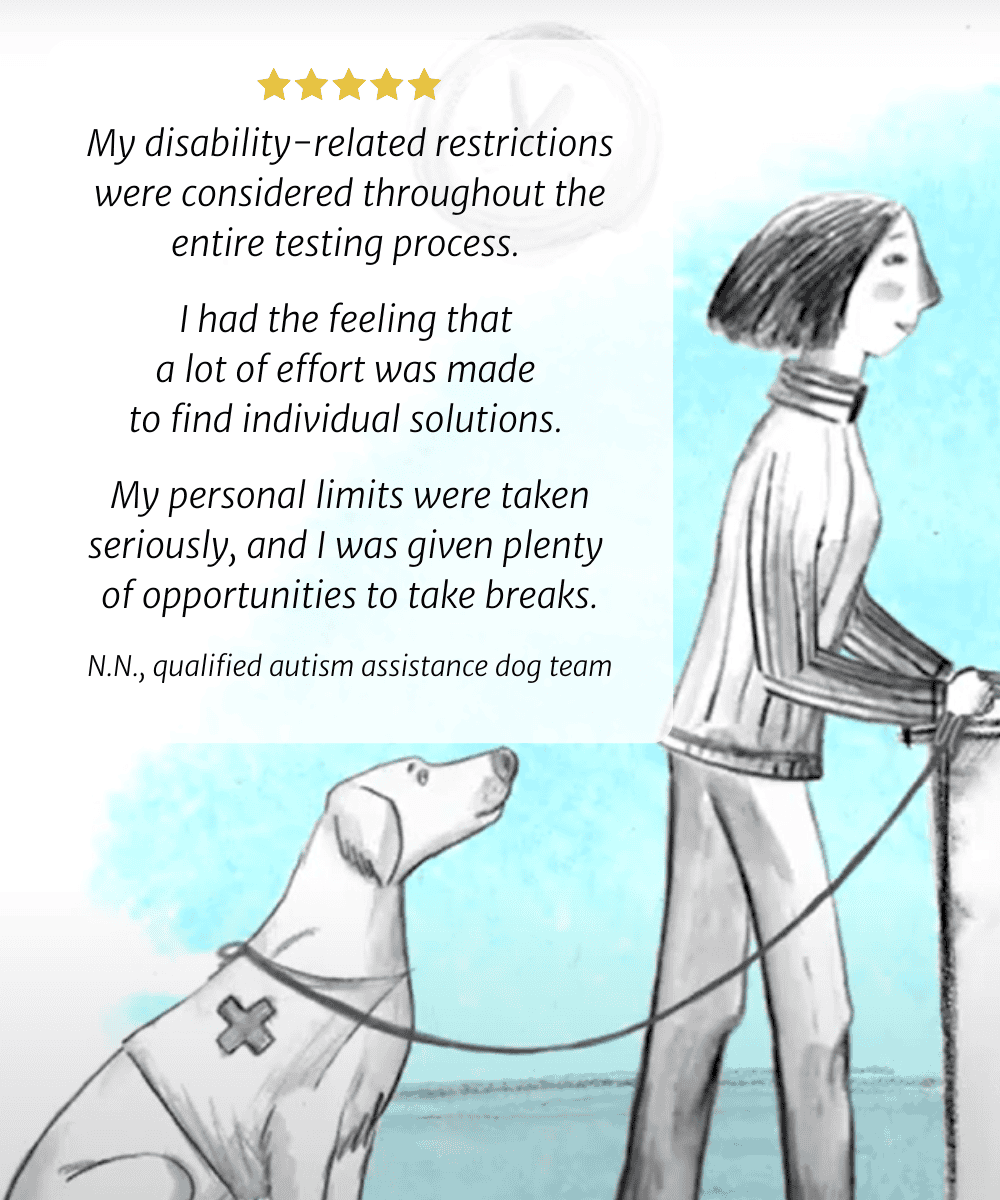
- The exam is often split into two sessions and includes breaks to reduce stress.
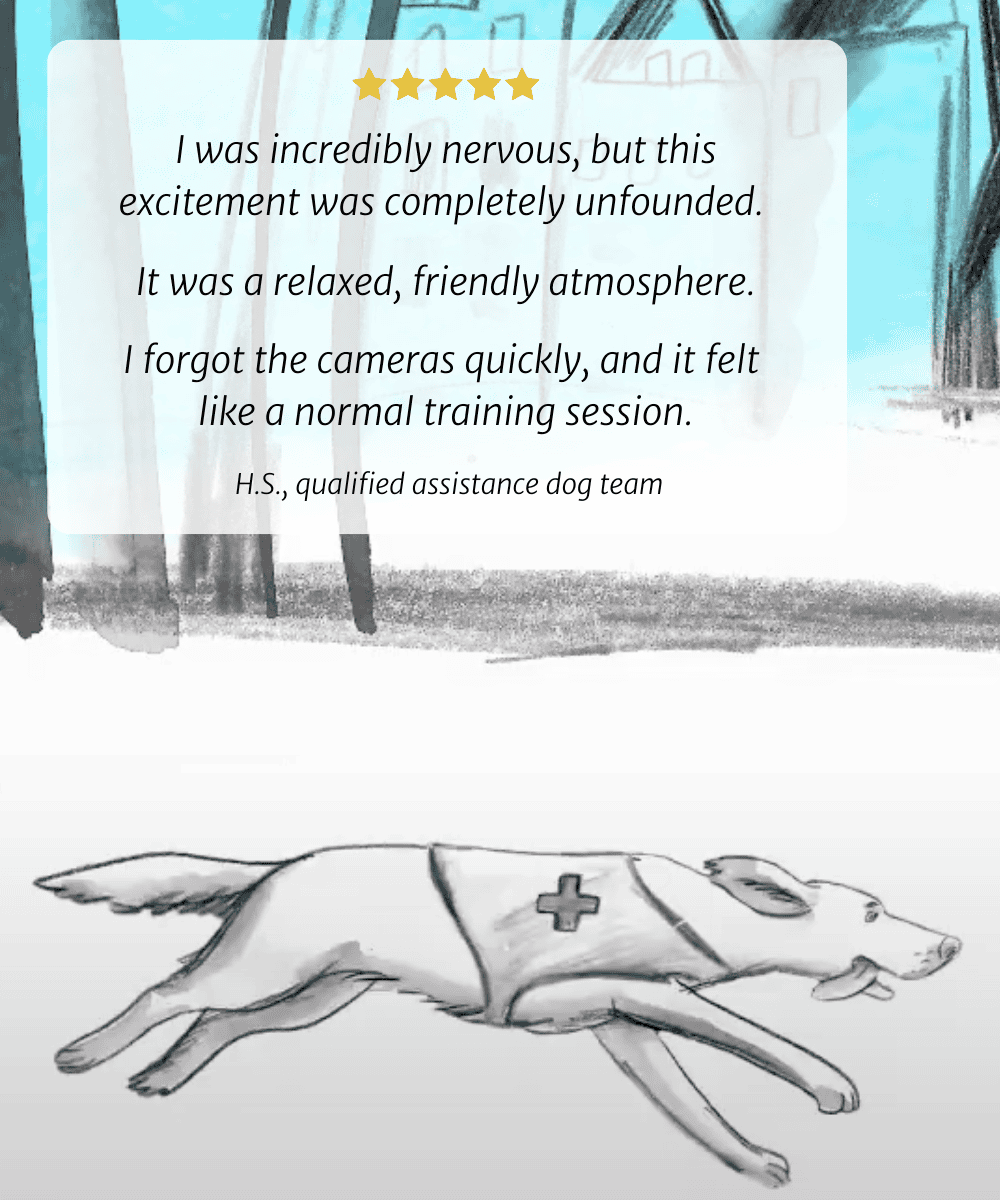
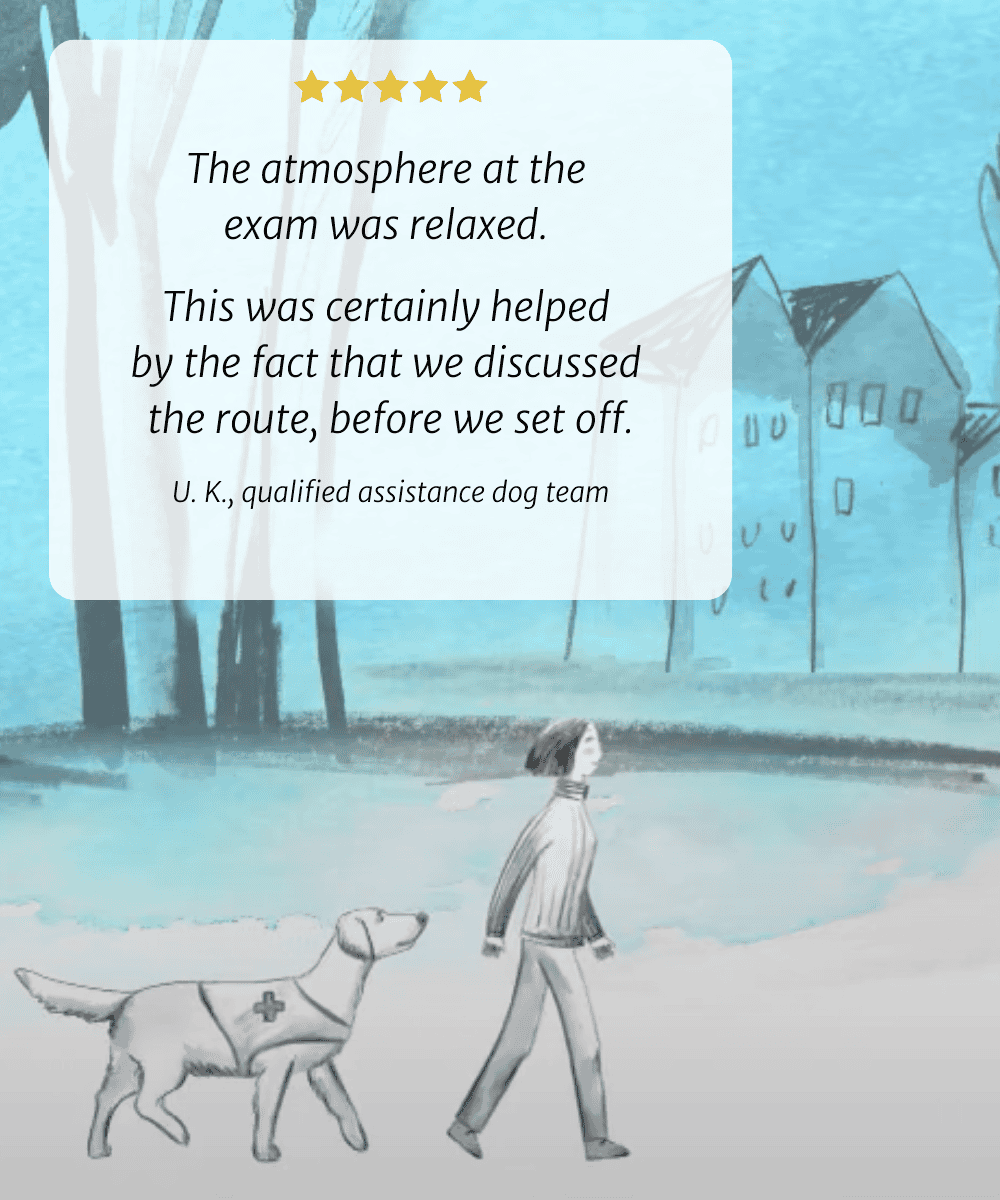
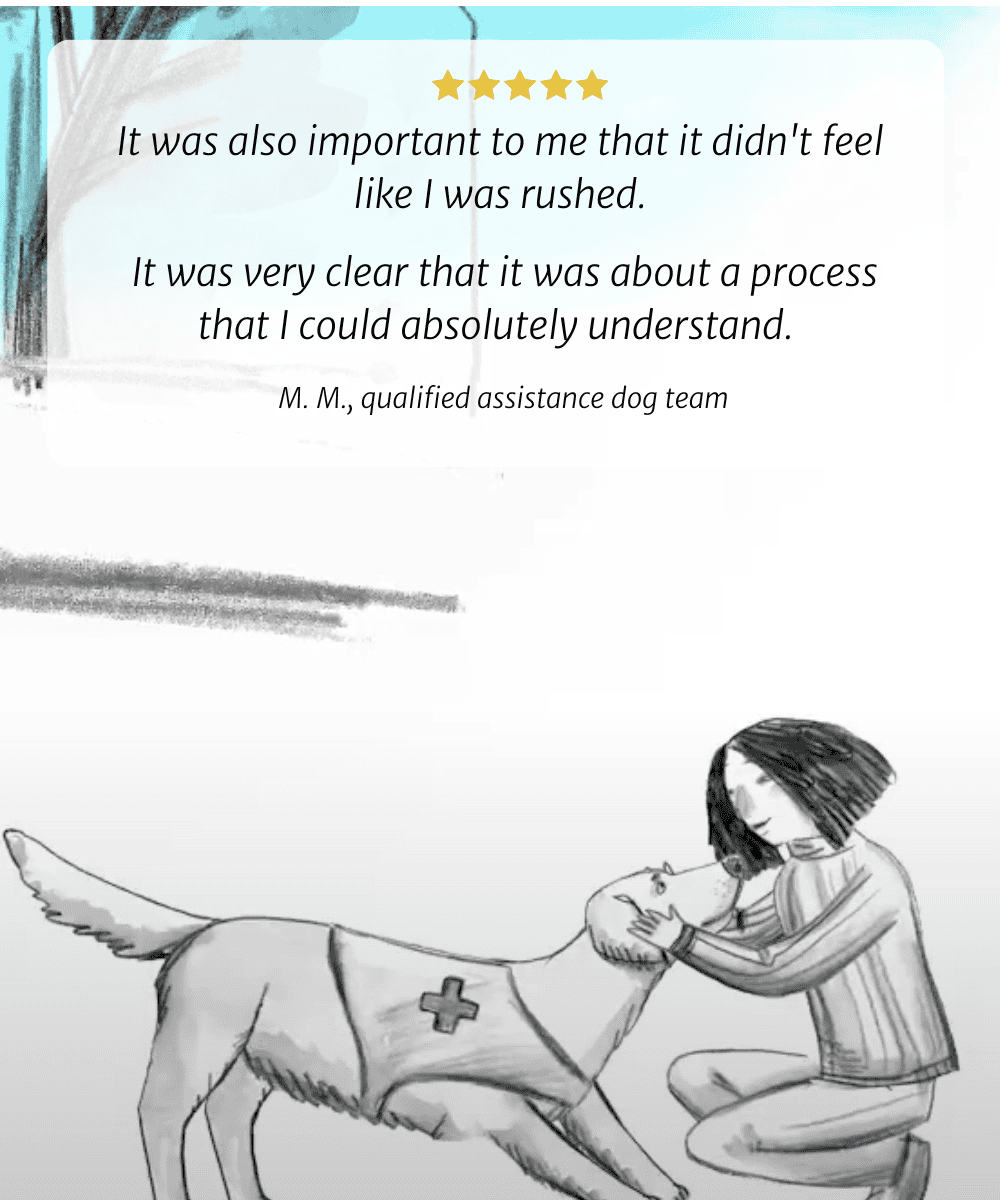
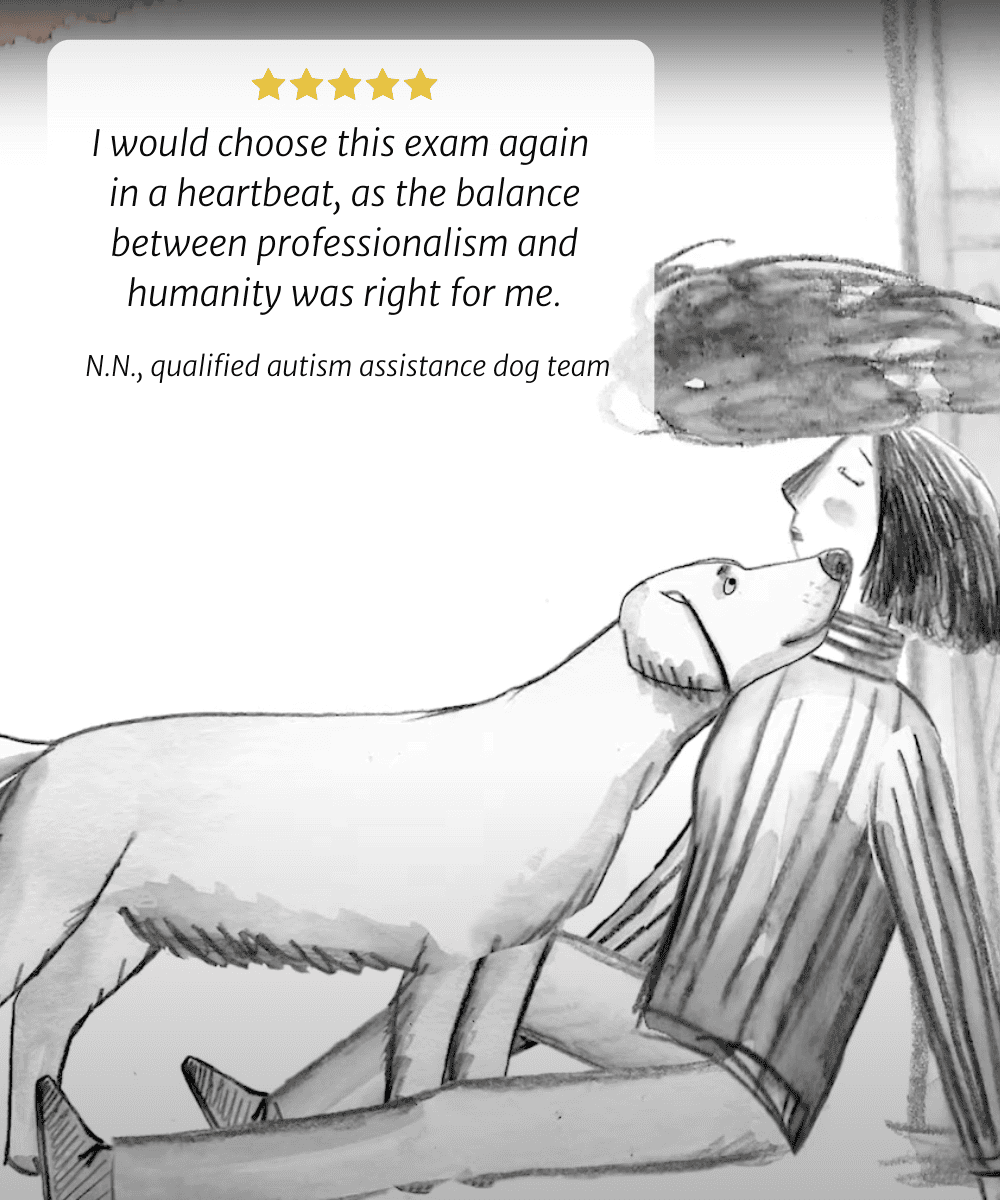
- Candidates regularly report that the process reduces stress and feels non-invasive.
What we capture
- Multiple viewpoints, including your perspective (what you see and hear).
- Share your self-assessment after the exam to be shared with the examiners (optional).
- Handler–dog interaction, the dog’s body language, and complete environmental context.
- Detailed video documentation, suitable for pause, rewind, and slow-motion review.
- Our cameras reliably capture the full environment, without limitation; nothing is missed.
Logistics & welfare
- While the requirements are set, we consider your input and disability-specific needs.
- Third parties may observe, but no longer need to, as video documentation is available.
- Since examiners do not incur travel expenses, we can be more flexible and affordable.
- If needed, the exam can be split over multiple days.
Why this beats old-style live exams
Fewer blind spots
- Multi-angle video shows details a single on-site view would miss.
- Focused, organized, documented remote exam supervision.
Lower stress
- No examiner entourage
- Familiar locations, meaningful tasks.
- Our ISO-style standards typically require 3-6 hours of examination. Sessions, however, can be adapted to your needs and even split over multiple days.
- Your examiners’ quality scores are also continuously measured and compared.
More accurate:
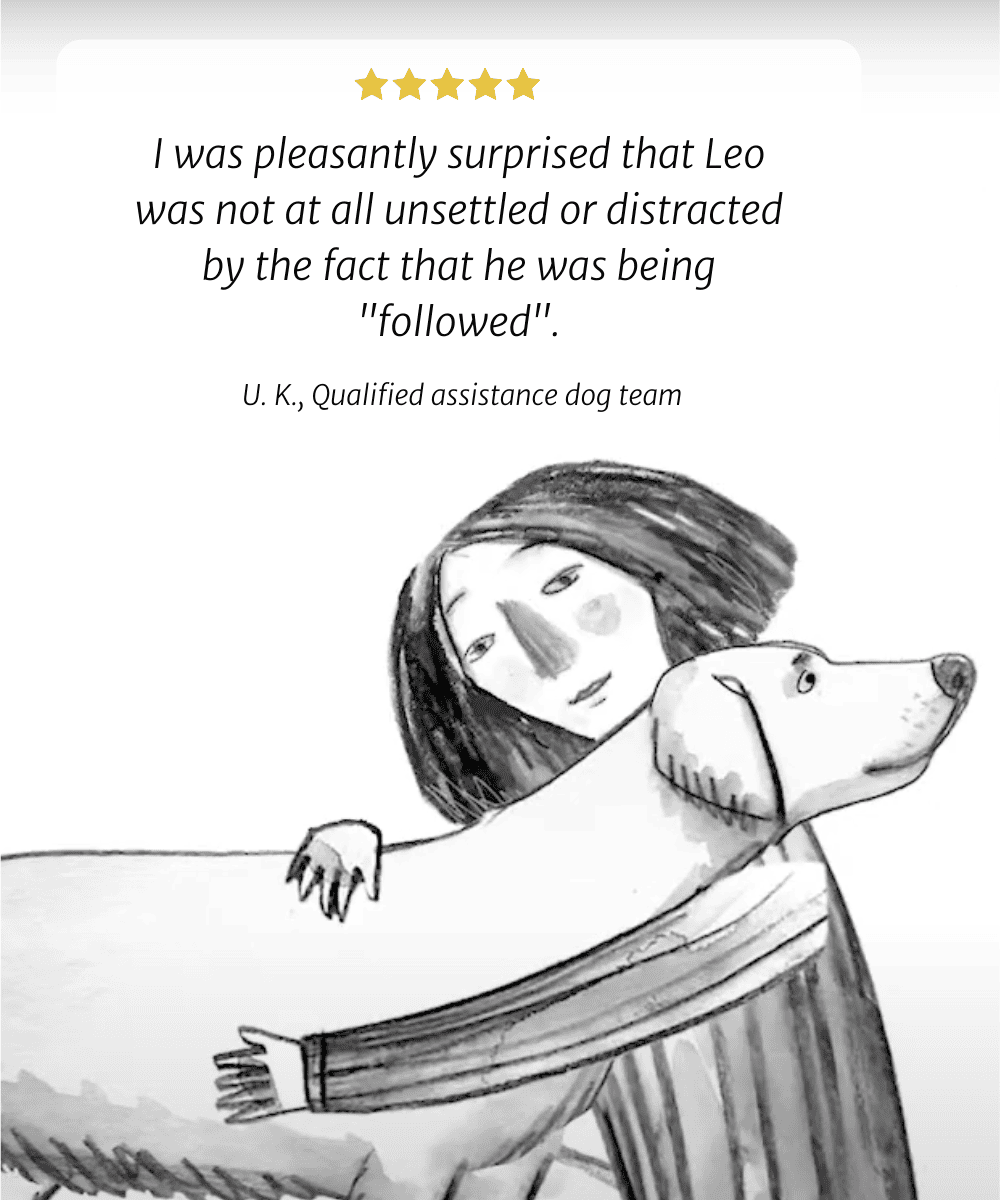
- Multiple views (yours, too) capture details someone following can’t see.
- When examiners multitask (observing, walking, planning, note-taking) accuracy suffers.
- Remote exam supervision remains focused at all times.
- Video evidence is reviewed with care, not in the rush of the moment.
How it works
- Examiners assess you later, undistracted, based on the video documentation and audio.
- They see multiple perspectives simultaneously, including the handler’s.
- The examiners may pause, rewind, zoom in and slow-mo the video as needed.
- Your name, location, assistance dog professional, or personal information are not disclosed.
- Logos and identifiers are covered. Teams are referenced only by an ID.
- The comments and scores of the other examiners remain private.
- Reflecting our certification scheme’s focus on human-dog partnership, examiners focus less on problems, and more on how you resolve them with your dog.
If scores differ
- Outlier ratings are flagged, reviewed, and notes compared.
- Only after careful review do we calculate your final result.
- We monitor the examiners’ performance data.
Disputes are simpler
- Questions can be resolved by re-checking relevant scenes together.
- No memory bias and discussions; the video is the record.
- Dispute resolution is easier than ever before.
If you don’t pass
- Partial re-tests are possible where appropriate.
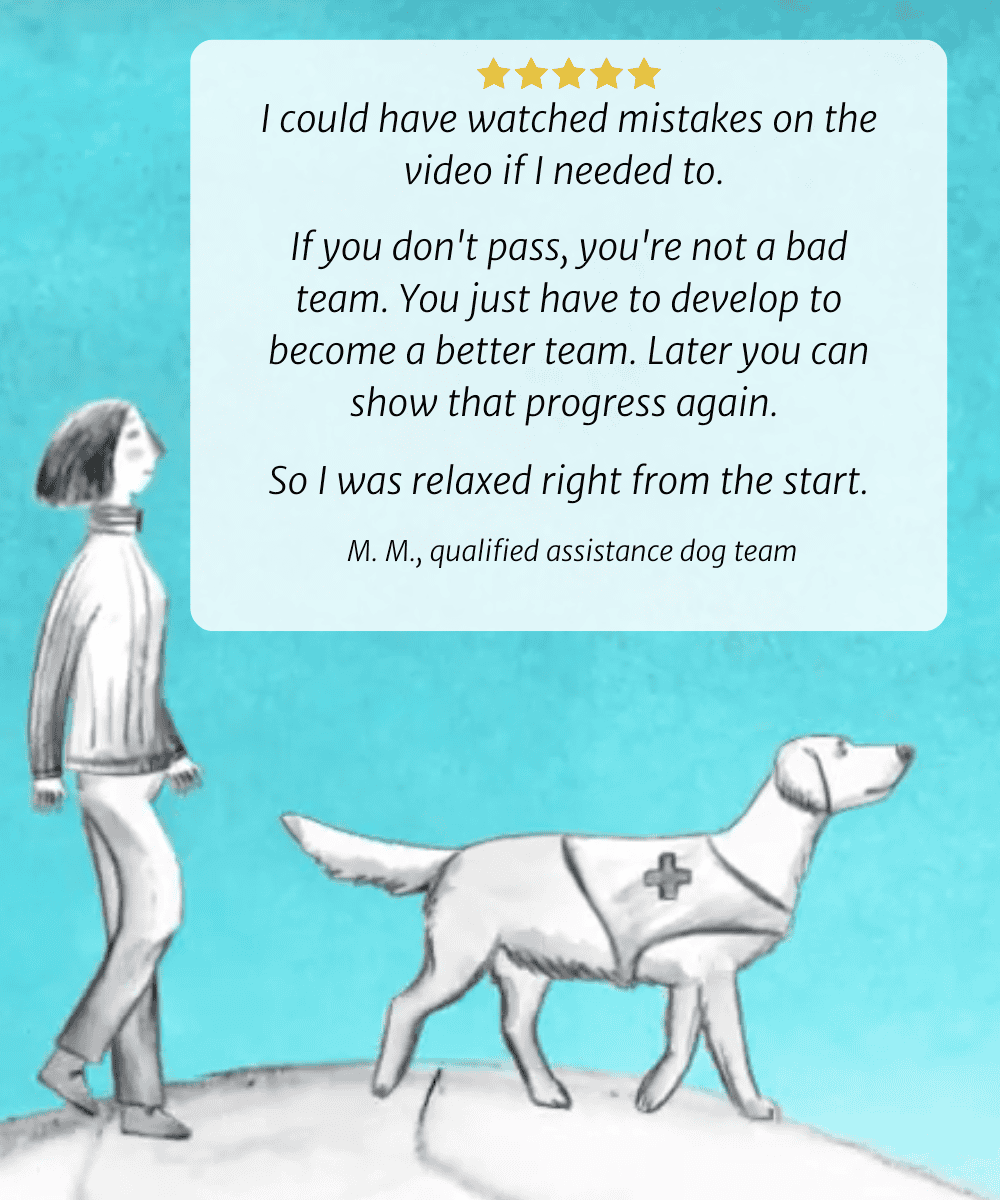
- The video allows for clear feedback with referenced scenes.
- A failed assessment turns into a learning opportunity and self-improvement.
Why video assessment is better
Less bias
- No personal data or groupthink introduces prejudice and bias.
- Sound observation replaces selective and subjective perception.
- “Nothing about us without us”: Typically, one examiner is an assistance dog handler with a similar disability.
Fairer decisions
- Multiple examiners rate you independently.
- Not influenced by others.
- We also measure and update your examiners’ quality scores.
Higher accuracy
- Multiple angles (incl. handler’s view) show details a live observer misses.
- Option to rewind and slow-mo.
- Every decision is based on time-stamped clips.
We provide a carefully optimized certification scheme for assistance dog teams as an independent nonprofit. For all things certification, we are your point of contact and also maintain a global register.
Responsibility for the full certification process itself, however, rests with a 3rd-party certification agency we recruit to comply with ISO-standards.
This setup ensures global validity of your certification while also ensuring that the process is informed by an organization deeply rooted in the assistance dog sector. The Assistance Dog Foundation also aims to keep costs low and secure additional support for certified teams.
Aftercare starts with certification and ends when the dog retires.
It is informed by feedback, evidence, fairness, and the team’s welfare.
Input and review
- We consider handlers and their service providers as partners.
- Our partnership extends through the entire certification period.
- We do not require recertification or a fixed retirement age.
- We stay open for questions and concerns.
- Complaints, grievances, and suggestions are logged and tracked to resolution.
- Complaints and incident reports are addressed with the concerned parties.
- We coordinate with your assistance dog professional when issues arise.
- Formal complaints/appeals are escalated, when needed, and require corrective actions.
Maintaining well-being and certification
- We see the certified handler as the competent manager of the assistance dog’s welfare.
- You may update your details, emergency contacts, and notes in our global registry yourself.
- Further documents or re-certification are only required if an issue demands it.
- As every team is different, we do not set a fixed retirement age.
- We trust you to monitor your dog’s fitness for work and plan its retirement.
- We nudge early planning for retirement provisions and the next dog, if desired.
Assistance Dog Foundation is deeply rooted in the sector as an independent nonprofit.
Committed to quality management, we continuously review and improve our certification scheme, processes, and strive to advance the sector overall.
Monitor and improve
- We apply the same quality standards and processes to every team.
- Regular internal and external audits result in published improvements.
- We monitor examiners’ performance and outcomes.
- We refine examiners’ guidance and education.
- Confidential feedback is welcome and we offer a private channel for suggestions and concerns.
- Review all input and fold accepted changes into the scheme.
- We use incident data and appeals to drive corrective actions.
Advance
- Teams and professionals may join research studies to strengthen welfare and acceptance.
- We share aggregated findings with the sector and build a comprehensive bibliography.
- Our registry serves as a reliable verification tool for the public, decision-makers, and funders.
- Keep an active dialogue with all stakeholders.
- Align updates with real-world needs without lowering standards.
Difference to traditional exams
Traditional exam programs can be rigid, their setup limiting true oversight. On-site assessment often leaves a sparse audit trail.
Candidates may have little recourse, since decisions are based on fleeting impressions. Processes may be improvised on the fly and cannot be independently reviewed: If they are not questioned, they will not improve.
Instead of transparency and quality management, the handler may feel unfairly evaluated and experience helplessness.